
This article is for you if…
You have ever replayed a conversation seventeen times before bed trying to figure out if someone meant it the way it felt. If you have ever talked yourself out of your own gut feelings, read because you wanted to be “fair.” If you have ever excused a pattern because the person had a hard childhood, a stressful week, or a really charming smile. If you have googled “am I too sensitive” more than once this year (be honest), this was written for you.
Specifically, this is for the high-functioning overthinker. The person who is brilliant at reading situations, terrible at trusting themselves. The one who gives breathtaking levels of emotional grace to people who do not particularly deserve it and then wonders why they are exhausted.
Most people who struggle with this are not lacking empathy. They are lacking a filter, a reliable way to sort what feels safe from what only feels familiar.
This article is going to give you that filter: a simple framework for recognizing who consistently leaves you feeling more like yourself, who keeps you guessing, and who quietly erodes your sense of peace over time.
The Day I Stopped Asking “But Why Would They Do That?”
Sarah, an office worker, had a coworker named Derek who had a gift for making her feel small in ways that were technically deniable. A joke here. A slight interruption there. A moment where her idea got restated by Derek as Derek’s idea, and somehow the room went with it. She had spent eight months trying to figure out his backstory in her head. Was he insecure? Was he threatened by her? Did he even realize he was doing it?
One question cut through all of it: “How do you feel after you interact with him?”
She said, without a pause: “Like I took up too much space and should apologize for it.”
That was the only data point she needed. And it had been sitting right there the whole time.
Maybe you have a Derek too. Maybe yours doesn’t work in your office. Maybe yours sits at your Thanksgiving table, or shows up in your text messages, or coaches your kid’s team.
The name changes. The feeling doesn’t.
How do you feel after you interact with them?
The Real Problem With “Giving People the Benefit of the Doubt”
Here is what nobody tells you about benefit-of-the-doubt culture: it was designed for ambiguous, one-time events. Not for patterns. Not for the third time someone has done the exact same thing with a slightly different wrapper on it.
We are wired, especially those of us with empathy running at full throttle, to explain. To contextualize. To humanize. These are genuinely beautiful instincts. They are also, in the context of repeated harm, a liability.
The question most people ask is: “But why would they do that?”
But the only question that actually matters is: “How do I feel after I’m around them?”
I often quote Research psychologist John Gottman, who has spent over three decades studying what makes relationships work or collapse. He put it plainly:
“Trust is built in very small moments.”
What he means by this is that trust is not forged in grand gestures. It is assembled (or quietly dismantled) in the tiny, repeated interactions that most people do not even consciously register.
The way someone responds when you share good news. Are they genuinely happy for you or privately feeling sorry for themselves because you ‘one-upped’ them?
Whether they remember the thing you mentioned mattered to you. Do they bring it up later, or does what you share seem to evaporate the moment the conversation moves on?
Whether a joke at your expense is a one-time stumble or a recurring feature of being in the room with them. And when you didn’t laugh, what did they do with that?
The accumulation is the data. And you have been collecting it. You just have not been reading it.
A Three-Color System That Has Nothing to Do With Feelings (And Everything to Do With Them)
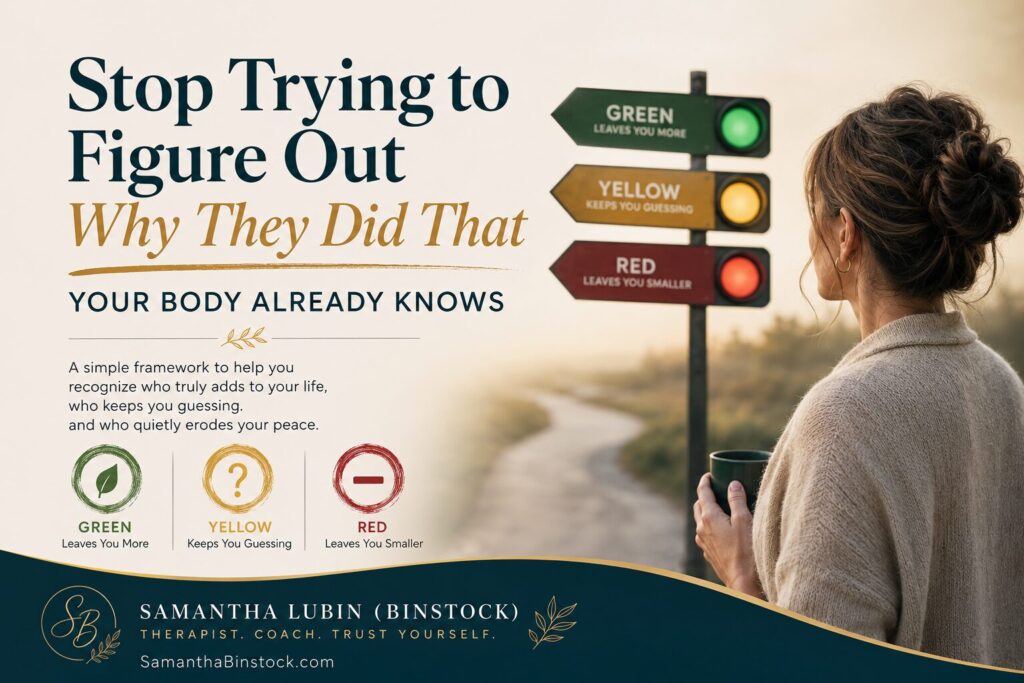
What I want to offer you now, is something I call the Trust Filter. It borrows from the simplest navigation system humans have ever invented. You already know how to use it. You learned it before you were six.
🚦 Green. Yellow. Red.

That is it. No personality diagrams. No attachment theory deep dives (though those have their place!). No spreadsheet of pros and cons (I will never recommend a spreadsheet!) Just three categories based on one thing: repeated impact over time.
Not what they intended. Not what they explained. Not what they were like that one time on the trip when everything was perfect. Impact. Over time.
🟢Green: The People Who Leave You More
You know a Green person by how you feel when you walk away from them. Not just good, but like yourself. Maybe even a sharper, fuller version of yourself.
Green is not about perfection. Green people disagree with you, have bad days, say the wrong thing occasionally. But the baseline is this: they respect your wins without needing to redirect the spotlight. They honor what you share with them. When you set a limit, they do not turn it into a negotiation. The interaction has a steadiness to it.
Invest here, generously and without overthinking it. These relationships are the ones worth tending.
🟢Yellow: The Ones Who Keep You Guessing
Yellow is not dangerous. Yellow is just inconsistent. (Which, if you are an anxious overthinker, can actually feel worse than dangerous because at least dangerous is predictable.)
Yellow people are warm sometimes and weirdly distant other times. They offer genuine support and then, seemingly at random, make it about themselves. There is no clear pattern of harm, but there is also no reliable pattern of safety.
The rule here is simple: match the energy they bring that day. Do not over-invest trying to crack the code or earn the consistent version of them. Some people are just situationally available, and that is useful information too. Observe over time. Let the pattern reveal itself without forcing a verdict.
🔴 Red: The Ones Who Leave You Smaller 🚨
Red is not necessarily dramatic. This is the part people get wrong. Red does not always look like a blowup or a betrayal. Sometimes Red looks like Derek from our story above.
The signals: your wins are consistently minimized or quietly redirected. The jokes land as disrespect, reliably. You have trusted someone with something that mattered and it was used against you, even once, in a way that was not accidental. And most telling of all: you feel drained, guarded, or somehow smaller after engaging with them.
The rule here is not to retaliate, catastrophize, or cut off dramatically (unless safety requires it). The rule is simply: reduce access. Keep interactions minimal and structured. Be cordial. Be professional, if required. But stop filling someone’s cup who keeps leaving yours empty on purpose.
The Part Where People Get Stuck (And Why)
The most common pushback I hear from clients when I introduce this framework is some version of: “But I don’t want to judge people.”
And I understand that impulse completely. Most of us were taught that judging is unkind. That good people extend grace. That the generous read is the right one.
But here is what I want you to sit with: tracking impact is not judgment. It is observation. You are not deciding that someone is a bad person. You are simply noticing what it costs you to be around them, repeatedly, and responding accordingly.
Leadership coach Charles Feltman, whose work on organizational trust has shaped how researchers and therapists understand this topic, defined trust as “choosing to make something important to you vulnerable to the actions of someone else.”
That is a choice. A conscious, repeatable choice. And it deserves to be made with information, not just hope.
What Brené Brown Gets Right (And What She Adds to This)
Brené Brown, whose research on vulnerability and shame has shifted the cultural conversation considerably, describes trust as “the stacking and layering of small moments and reciprocal vulnerability over time.”
Stacking. Layering. Over time.
Not one conversation. Not one grand gesture. Not the version of someone you met on their best day.
What this means for your Green, Yellow, and Red categories is that you are not making a verdict. You are reading an accumulation. And the accumulation is allowed to change. People can move from Yellow to Green as they demonstrate consistency. People can move from Yellow to Red as patterns clarify. The filter is not a life sentence; it is a living, updated read.
What it is not, however, is an invitation to keep waiting indefinitely for someone to stop doing the thing they keep doing.
The One Principle That Holds All of This Together
You are not trying to decode intent.
This is the whole thing. This is the piece that will actually change something for you if you let it.
You are not a detective. You are not a therapist to the people in your personal life (even those of us who are therapists by profession). You are not responsible for reconstructing someone’s motivations from first principles.
You are tracking repeated impact over time. That is the only question: what is it like to be in relationship with this person, consistently, across different contexts?
Maya Angelou said it in a way that nobody has ever improved upon:
When someone shows you who they are, believe them the first time.”
(She was reportedly fond of adding that the problem is not that people do not show us. The problem is that we spend so much time and energy hoping the showing was a one-time exception.)

The Quiet Permission Slip 📜
One thing I watch happen in my practice, over and over, is the relief that arrives when someone finally gives themselves permission to stop contorting around someone else’s inconsistency.
Not permission to be cold. Not permission to carry resentment around like a backpack. Permission to simply… stop investing in a direction that keeps losing ground.
You are not required to be equally available to everyone who has access to you. You are not required to be endlessly generous with your attention toward people who have consistently shown you they will not hold it with care. You are allowed to have a tiered system. (Everyone does, by the way. Most people just do not say it out loud.)
Green gets your full presence. Yellow gets appropriate energy. Red gets your cordial, structured minimum.
And the space that clears when you stop hemorrhaging energy toward Yellow and Red? That goes to the Greens. The ones who fill you back up. The ones who make you feel like yourself on a good day, not like someone performing a more palatable version of yourself for an audience that is not really paying attention anyway.
The Last Thing
Here is the question I want to leave you with, and I want you to answer it about one specific person you have been circling back to mentally while reading this:
After being with them, do you feel more like yourself or less?
You already know the answer. You have known it for a while, probably. The filter is not about learning something new.
It is about trusting what you already know.
All stories and characters in this article are fictional. Any resemblance to real persons or situations is purely coincidental.
Samantha Lubin (Binstock) is a therapist and coach who works with high-achieving individuals navigating relationships, identity, and the complicated business of actually trusting themselves. Find her at SamanthaBinstock.com.
🌿 Enjoyed this post?
Let’s keep the conversation going.
Join our newsletter for gentle reminders, wellness tools, parenting tips, and soulful reflections—delivered with care, not clutter. 💌
✨ You’ll also get early access to guides, seasonal self-care ideas, and special updates from Samantha, LPC & founder of Post Oak Family Wellness.
Sign up here and stay connected.