
Building a Collaborative Network for Family Stabilization, Wellness, and Lifelong Learning
Living prospectus — Last reviewed September 2026
- Building a Collaborative Network for Family Stabilization, Wellness, and Lifelong Learning
- 1. Primary Inclusion Criteria (Must meet at least one)
- 2. Additional Considerations
- 3. Exclusion and Alternative-Referral Criteria
- 4. Flexibility Notes
- 1. Intake & Coordinated Needs Assessment
- 2. Family Stabilization Plan (FSP)
- 3. Care Coordination & Navigation Support
- 4. Clinical Consultation & Referral Pathways
- 5. Referrals, Warm Handoffs & Partner Integration
- 6. Progress Monitoring & Outcome Tracking
- 7. Program Completion & Transition Support
- 1. Data Privacy & Confidentiality
- 2. Safety Protocols
- 3. Boundaries for Volunteers
- 4. Technology & Communication Guidelines
- 5. Supervision & Support for Volunteers
- 6. Commitment to Ethical Practice
- 1. Proposed Initial-Stage Outcomes
- 2. Intermediate-Stage
- 3. Proposed Longer-Term Outcomes
- 4. Proposed Data Collection Methods
- 5. Planned Impact Reporting for Partners
- 6. Continuous Improvement & Feedback Loops
- 7. Working Definition of Stabilization
- Partnership Contacts
Vision & Mission
Vision: To create a world where families and communities thrive through connection, education, and coordinated support.
Mission: The Concordia Initiative brings together mental health professionals, educators, systems specialists, and community partners to develop coordinated pathways for wellness, stabilization, learning, and sustainable growth.
Foundational Frameworks
These frameworks define the language, methodology, and shared ethos across all Concordia Initiative-aligned projects.
| Framework / Layer | Purpose | Anchored Project |
|---|---|---|
| Wellness, Wealth & Beauty™ | A holistic lifestyle framework integrating emotional health, financial literacy, and authentic self-expression. | Concordia community programs, LJ Learn |
| Mindful Mom & Dad™ | A parenting education and connection model focused on emotional intelligence and mindful communication. | Post Oak Family Wellness |
| LJ Learn | Educational and operational backbone for training, volunteer onboarding, workflow design, digital systems governance, and program evaluation. | Training, Systems & Evaluation Infrastructure |
| Post Oak Family Wellness | Independent clinical branch providing separately consented and documented counseling, child trauma therapy, family-centered services, psychoeducation, and appropriate clinical consultation. | Clinical Services & Referral Pathways |
| Concordia Initiative | The umbrella collaboration framework connecting clinical, educational, operational, and community initiatives around a shared mission. | Partnership Network |
| Leadership | Laban Johnson – Education, strategy, and HIPAA-aligned digital systems governance Samantha Lubin, MS., M.Ed, LPC – Therapy, clinical oversight, and community mental health | Guiding stewardship |
Program Overview: Care Coordination for Families in Crisis (CCFIC)
CCFIC is a developing family-support and care-coordination initiative designed to help people navigate fragmented clinical, educational, social-service, and community systems. Its role is to organize information, strengthen referral pathways, support follow-through, and help families connect with appropriately qualified providers and resources. CCFIC does not replace emergency services, legal representation, medical care, or independently delivered psychotherapy.
Strategic Priorities for the Current Development Horizon
| Priority | Objective | Expected Impact |
|---|---|---|
| Family Stabilization | Build an integrated referral and care coordination network for families in crisis. | Reduce fragmentation, improve family outcomes |
| Education & Training | Develop volunteer and professional training programs rooted in the Mindful Mom & Dad™ framework. | Strengthen local workforce readiness |
| Technology Integration | Develop and govern a protected, human-reviewed Google Workspace coordination environment with structured intake, workflow automation, role-based access, and aggregate reporting. | Secure, scalable, and accountable coordination supported by clearly defined access controls and human oversight. |
| Community Engagement | Establish Concordia Ambassadors across regions to build partnerships and organize events. | Increased visibility and sustainability |
| Sustainability Alignment | Advance initiatives align program activities and outcome reporting, where applicable, with UN Sustainable Development Goals 3 (Good Health and Well-Being), 4 (Quality Education), 10 (Reduced Inequalities), and 17 (Partnerships for the Goals). | A clearer impact framework, stronger partner alignment, and more credible grant and program reporting. |
Eligibility and Service-Fit Criteria (Who CCFIC Is Designed to Serve)
These criteria provide an initial framework for referral, pilot planning, and grant development. Final eligibility may depend on program capacity, funding requirements, service availability, safety considerations, and the terms of specific partnerships.
1. Primary Inclusion Criteria (Must meet at least one)
- Active family crisis or instability, such as:
- Risk of separation, domestic conflict, or child welfare involvement
- Housing insecurity or imminent homelessness
- Mental health concerns affecting functioning, such as:
- Untreated or under-treated depression, anxiety, trauma, or behavioral issues in parent or child
- Barriers to accessing resources without support, e.g.:
- Difficulty navigating school, healthcare, or social service systems
- Referrals from trusted sources, such as:
- Schools, clinics, pediatricians, social services, or community organizations
2. Additional Considerations
- Willingness and practical ability to participate in an agreed care-coordination plan and reasonable follow-up activities; psychotherapy is separate and is not required unless specifically established by an applicable program or funding model
- Willingness to participate in collaborative planning and reasonable follow-through on agreed stabilization goals
- Ability to provide informed consent or, when applicable, to have consent provided by a legally authorized representative; minors should be included through developmentally appropriate assent when appropriate
3. Exclusion and Alternative-Referral Criteria
CCFIC may be unable to accept or continue a referral when the person or family:
- Requires immediate emergency or crisis-response services beyond CCFIC’s scope, including situations involving imminent danger, active suicidal intent, or an acute medical or psychiatric emergency; the person should be connected promptly with 911, 988 when appropriate, or another qualified emergency or crisis service
- Has primary needs requiring services that CCFIC does not provide, such as medically supervised withdrawal management, inpatient or residential treatment, legal representation, or long-term residential care
- After reasonable engagement efforts and available accommodations, is unable or unwilling to participate in the minimum activities necessary for safe and effective care coordination
- Is already participating in another intensive care-coordination program where CCFIC involvement would create unnecessary duplication, conflicting plans, or unclear responsibility—unless the programs establish an authorized and clearly defined coordination arrangement
4. Flexibility Notes
- Eligibility decisions should consider safety, identified needs, program scope and capacity, informed participation, equitable access, applicable funding requirements, and the likelihood that CCFIC can provide meaningful coordination support.
- When capacity and suitable resources permit, CCFIC will offer referral information or a warm handoff to a more appropriate service for individuals who are not eligible or whose needs fall outside the program’s scope.
- Eligibility, service-fit, and referral decisions will be documented in accordance with privacy requirements, program policies, evaluation needs, and applicable funding or grant obligations.
Current implementation stage — September 2026
CCFIC is in phased development. Its initial intake and protected coordination infrastructure has been established in a protected Google Workspace, and initial inquiries are being accepted. Partner, volunteer, clinical, and reporting functions will be activated in stages as operating protocols, training, access controls, and capacity are confirmed. Features described below represent the intended service model unless identified as currently available.
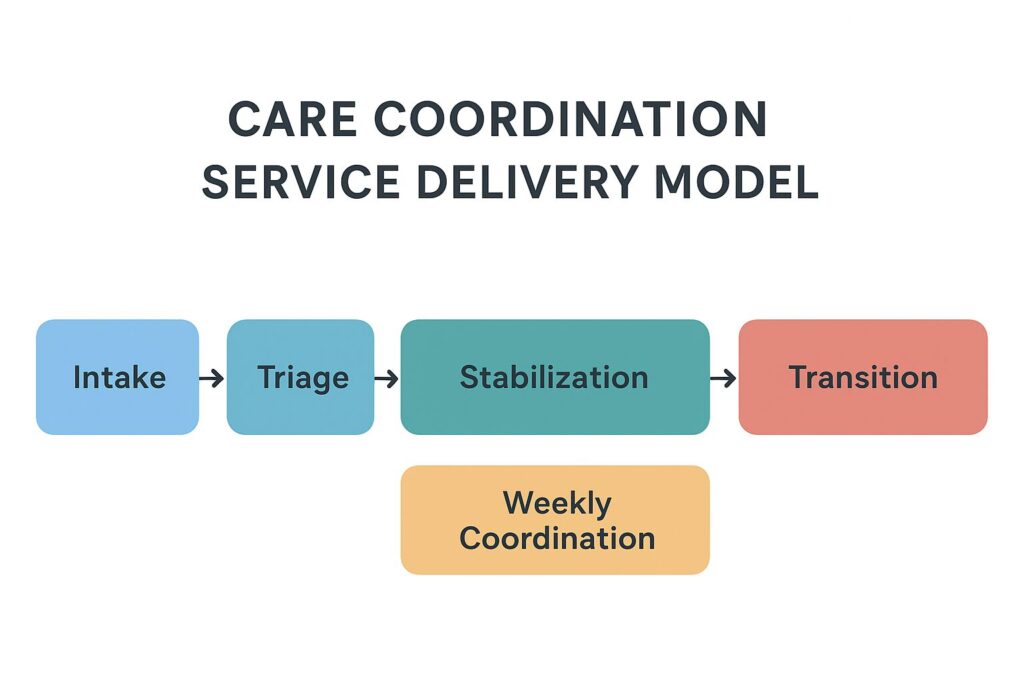
Service Delivery Model
Care Coordination for Families in Crisis (CCFIC)
Under the Concordia Initiative & Post Oak Family Wellness
CCFIC is developing a coordinated, trauma-informed, family-centered service model for households navigating significant stress, behavioral-health concerns, resource barriers, or involvement with multiple systems. The intended model connects care navigation, resource coordination, referral follow-through, and separately delivered clinical services when appropriate—helping reduce the risk that families are lost between disconnected systems.
1. Intake & Coordinated Needs Assessment
When a referral is accepted, an appropriately trained and authorized coordinator completes a structured program intake focused on the family’s goals, needs, existing supports, and coordination barriers. Any clinical or diagnostic assessment is conducted separately by a qualified licensed professional within an appropriate clinical relationship.
Components include:
- Identification of self-reported mental and behavioral health needs, existing providers, and possible referral needs—without diagnosis or independent clinical determination by non-clinical personnel
- Review of reported safety concerns, housing stability, financial stress, and basic needs, with escalation of safety concerns under the approved protocol
- Family-identified communication, caregiving, and coordination challenges relevant to the requested support
- Review of existing supports (schools, medical providers, caseworkers)
- Identification of urgent coordination needs, family-identified priorities, and concerns requiring referral or escalation under the approved protocol
When a family enters the program, information gathered through intake and the coordinated needs review may inform a collaborative Family Stabilization Plan (FSP) outlining agreed goals, supports, responsibilities, and review points.
2. Family Stabilization Plan (FSP)
Participating families may develop a personalized Family Stabilization Plan with CCFIC to organize priorities, reduce coordination barriers, and strengthen sustainable support.
The FSP includes:
- Family-identified short-term stabilization goals and, when clinically necessary, reference to a safety plan developed by an appropriately qualified professional
- An agreed follow-up cadence based on family needs, program capacity, funding requirements, and the level of coordination being provided
- Referrals with warm handoffs to community partners
- Authorized coordination with existing or referred clinical providers when relevant to the family’s goals and permitted by appropriate consent or authorization
- Milestones for tracking progress
The plan is reviewed at agreed intervals and when material circumstances change, with updates documented collaboratively and within the scope of CCFIC’s role.
3. Care Coordination & Navigation Support
Depending on program acceptance, staffing, and the agreed service plan, authorized care coordinators may provide relational navigation support through:
- Check-ins at an agreed cadence through approved phone, video, or in-person channels
- Administrative assistance locating, understanding, and completing appropriate applications for public benefits, housing, or legal-support services—without providing legal or financial advice
- Authorized coordination with schools, healthcare providers, social-service agencies, and community partners when relevant to the family’s goals
- Documenting referral status and supporting family follow-through; final eligibility and acceptance decisions remain with the receiving provider or agency
- Supportive, non-clinical problem-solving during periods of stress, with referral or escalation when needs exceed CCFIC’s role
The intended approach emphasizes continuity, shared accountability, clear follow-through, and warm human connection—elements that can reduce avoidable breakdowns in service engagement.
4. Clinical Consultation & Referral Pathways
CCFIC care coordination is distinct from psychotherapy. When clinically appropriate and available, counseling may be offered separately through Post Oak Family Wellness or another qualified provider, subject to separate intake, informed consent, clinical records, eligibility, and financial arrangements. Participation in CCFIC does not guarantee placement in therapy.
When arranged separately with a qualified clinical provider, available services may include:
- Trauma-informed individual therapy for adults, adolescents, and children, including child trauma therapy when clinically appropriate
- Parent coaching and emotional regulation skills
- Family therapy sessions
- Clinical risk assessment, safety planning, and referral to appropriate crisis or emergency services when provided by a qualified clinician
- Psychoeducation on stress, trauma, and coping strategies
- Caregiver consultation and coordination with existing treatment providers when clinically appropriate and properly authorized.
Any clinical services are governed by the treating provider’s professional scope, availability, informed-consent process, and clinical-recordkeeping requirements.
This coordinated model recognizes the relationship between clinical and practical needs while maintaining appropriate boundaries between care coordination and separately delivered clinical services.
5. Referrals, Warm Handoffs & Partner Integration
CCFIC seeks to develop trusted relationships with community organizations, providers, and agencies to strengthen referral pathways and reduce fragmentation.
We provide:
- Direct referrals and introductions to appropriate providers or community resources
- Follow-up with families and, when authorized, receiving organizations to clarify referral status
- Minimum-necessary progress updates shared with authorized partner organizations
- Collaborative problem-solving for complex coordination barriers within each participant’s and partner’s defined role
This strengthens the entire support ecosystem—not just a single point of service—while keeping each family’s goals, consent, and privacy at the center.
6. Progress Monitoring & Outcome Tracking
With appropriate authorization, CCFIC may monitor agreed service and outcome domains such as:
- Referral engagement and follow-through
- Family-reported stress, stability, and coordination needs
- Housing, employment, childcare, or other relevant resource stability
- School engagement or family-reported educational concerns
- Connection to independently delivered therapeutic or supportive services
- Changes in the frequency of reported crises or emergency-system involvement
Program information may be collected through approved surveys, care-coordination records, participant feedback, and authorized service-utilization information. Clinical notes remain within the designated electronic health record and are not treated as general CCFIC program records.
7. Program Completion & Transition Support
When agreed coordination goals are substantially met—or when services otherwise conclude—CCFIC may work with the family to develop an appropriate transition or closure plan.
We provide:
- A transition or closure summary identifying relevant resources, contacts, and next steps
- Follow-up at agreed intervals when appropriate and supported by program capacity
- Information about separately available therapeutic services through Post Oak Family Wellness or other qualified providers
- Referrals to longer-term community or professional support networks when available
The goal is for families to conclude coordination with greater clarity, stronger connections, and increased confidence navigating the systems relevant to their needs.
The intended CCFIC service model is organized around three coordinated components:
- Intake & Collaborative Planning – Coordinated needs review and an agreed stabilization roadmap
- Care Coordination – Weekly support, resource navigation, and system bridging
- Clinical Consultation & Referral – Connection to appropriate therapy and other clinical services through separate, authorized pathways
This relational approach is intended to help families move from fragmented crisis navigation toward stronger connections, greater clarity, and sustainable support.
Partnership Tiers
Tier 1: Direct Service & Clinical Partners
Collaborate with local and regional providers to coordinate family support, strengthen referral pathways, and connect participants with separately delivered therapeutic services when appropriate.
Tier 2: Educational & Training Partners
Collaborate with universities, professional organizations, and learning platforms to develop training curricula and explore continuing-education offerings through appropriately approved partners.
Tier 3: Community & Faith-Based Partners
Build local coalitions of trust, inclusion, and mutual aid rooted in shared values.
Tier 4: Strategic & Global Partners
Align with organizations advancing community wellbeing, ethical technology, systems collaboration, and sustainable social impact.
What We Offer Partners
- Access to interdisciplinary expertise in clinical practice, education, digital systems governance, program design, and evaluation
- Opportunities to collaboratively develop training and events using established Concordia Initiative frameworks, including Mindful Mom & Dad™ and Wellness, Wealth & Beauty™
- Volunteer training, onboarding, and competency documentation through LJ Learn
- Planned aggregate impact reporting and appropriately governed evaluation or research collaboration opportunities
- Alignment with global sustainability goals (UN SDGs)
Data Privacy, Safety & Volunteer Boundaries
The Care Coordination for Families in Crisis program upholds the highest standards of privacy, safety, and ethical practice. Because families are often in vulnerable situations, we maintain clear guidelines to protect clients, volunteers, and the integrity of our services.
1. Data Privacy & Confidentiality
Protected Information & HIPAA-Aligned Practices
CCFIC applies protected-information safeguards to all family and case-related information, whether or not a particular interaction constitutes a clinical service. PHI and identifiable case information are handled only within approved protected systems using role-based, minimum-necessary access. These practices include:
- Protecting all personal and family information shared verbally, digitally, or in writing
- Restricting access to individually authorized personnel whose roles, training, confidentiality obligations, and system permissions have been approved
- Storing clinical records in the designated electronic health record system and approved care-coordination records within CCFIC’s protected Google Workspace environment, according to record type
- Using only approved, access-controlled communication channels—including designated Workspace accounts and EHR messaging—for sensitive information
- Keeping PHI and identifiable case information out of public forms, non-PHI intake streams, and any system not approved for protected case information
Minimum Necessary Rule
Each authorized person receives access only to the minimum information necessary for an approved role or assigned task. Access may be limited, changed, or revoked as responsibilities and program needs change.
Information Sharing
Identifiable family or case information is shared only with appropriate authorization or when otherwise permitted or required by law, and only through approved communication channels. Any disclosure is limited to the information reasonably necessary for its authorized purpose.
2. Safety Protocols
Risk Screening & Clinical Oversight
Non-clinical personnel and volunteers do not conduct clinical risk assessments, determine a person’s level of danger, or independently direct emergency or safety responses.
Any expressions of:
- suicidal ideation
- threats of harm
- domestic violence
- child endangerment
- substance-related emergencies
must be handled under the current approved escalation protocol, including prompt notification of the designated clinical or program lead. If someone appears to be in immediate danger, emergency services should be contacted without waiting for an internal response.
Emergency Response
CCFIC is not an emergency-response service. Non-clinical personnel and volunteers must not attempt to provide crisis intervention beyond their training and approved role. They must follow the current emergency-escalation protocol, which includes:
- Prioritize personal safety and do not enter, remain in, or attempt to control an unsafe situation.
- Notify the designated clinical or program escalation contact using the current contact method identified in the approved protocol.
- If someone appears to be in immediate danger, call 911 or the appropriate local emergency service. For a mental health or suicide crisis in the United States, call or text 988 for the Suicide & Crisis Lifeline.
- Document the event promptly through the approved protected incident-reporting process, recording only the information required by the current protocol.
Mandatory reporting, clinical risk assessment, crisis intervention, and safety planning are handled only by appropriately qualified professionals acting within their roles and applicable legal and ethical requirements.
3. Boundaries for Volunteers
Role Clarity
Once appropriately screened, trained, and authorized, volunteers may support families through approved non-clinical navigation tasks such as:
- locating resources
- helping complete non-sensitive forms
- providing encouragement and accountability
- supporting authorized administrative communication among families, partner organizations, and the program
Unless separately credentialed, formally engaged, and explicitly authorized to act in a distinct professional capacity, volunteers are not responsible for:
- Therapy, counseling, or other clinical services
- Crisis response, clinical risk assessment, or safety determinations
- Legal advice or representation
- Eligibility, placement, or case decision-making
Volunteers may not transport clients while acting on behalf of CCFIC.
Relationship Boundaries
To avoid dual relationships and protect all parties:
- Volunteers do not give rides, gifts, or money to clients
- Volunteers do not socialize or meet outside of scheduled program activities
- Personal disclosures should be minimal and purposeful
- Volunteers may not exchange personal phone numbers or social media accounts
All communication must occur through approved program channels.
4. Technology & Communication Guidelines
- Digital communication involving protected family or case information must occur only through approved, access-controlled Workspace or EHR communication channels appropriate to the information being shared.
- Protected family or case information may not be downloaded to or stored on personal devices unless explicitly authorized and the device meets current approved security requirements.
- Case documentation must be entered and maintained only within designated protected record systems—not in personal notes, consumer messaging applications, or other unapproved locations.
5. Supervision & Support for Volunteers
To ensure quality and safety:
- Before receiving an assignment or system access, volunteers must complete role-appropriate onboarding covering trauma-informed engagement, communication boundaries, privacy, safety escalation, and information-handling requirements.
- Active volunteers receive scheduled supervision and guidance from the designated program or clinical lead appropriate to their assignments.
- Volunteers may request assistance or reassignment at any time.
- Clinical decisions remain the responsibility of the appropriately qualified licensed clinician acting in the designated clinical role; they are never delegated to volunteers or automated systems.
6. Commitment to Ethical Practice
The CCFIC model is designed around consistency, compassion, professional accountability, clear boundaries, and careful protection of family information. These commitments support an environment in which families can seek coordination assistance with dignity and trust.
As volunteer functions are activated, CCFIC will treat volunteer preparation, supervision, safety, and wellbeing as essential components of responsible program implementation.
Outcomes & Impact Measurement
CCFIC is developing a staged outcomes framework to evaluate stabilization, access to services, family functioning, and longer-term resilience. The indicators below represent intended measures and will be implemented as program capacity, participant authorization, data quality, and appropriate professional oversight allow. They are evaluation targets—not guaranteed individual outcomes.
1. Proposed Initial-Stage Outcomes
Intended outcomes during a family’s initial period of engagement, focused on stabilization, navigation, and connection to appropriate resources.
Family Stability & Stress Reduction
- Participant-reported reduction in immediate coordination burden, crisis intensity, or caregiver stress
- Greater clarity about immediate next steps, available supports, and household routines; connection to qualified safety-planning support when clinically indicated
Service Access & Engagement
- Connection to one or more agreed services or resources, subject to availability and participant choice
- Participation in agreed care-coordination contacts
- Completion of a Family Stabilization Plan
Communication & Trust Building
- Family-reported improvement in caregiver-child communication when relevant to the family’s goals
- Development of a collaborative and appropriately bounded working relationship with the assigned coordinator
Proposed Initial-Stage Indicators
- Participant-reported change in stress or coordination burd
- Participation in agreed coordination contacts
- Number and status of agreed referrals
- Completion or review of a Family Stabilization Plan when applicable
- Appropriately documented coordinator observations and participant feedback
2. Intermediate-Stage
Intended outcomes as families engage with referrals, strengthen follow-through, and work toward improved individual and family functioning.
Mental Health Indicators
- Participant-reported or clinician-measured change in mental health symptoms when separate clinical services are involved
- Increased use of developmentally and culturally appropriate coping or emotional-regulation skills
Family Functioning
- Family-reported reduction in disruptive conflict and improvement in workable household routines
- Increased caregiver confidence in navigating systems
Resource Stability
- Progress toward family-identified housing, childcare, financial, employment, or educational goals
- Connection to and engagement with chosen therapeutic, medical, educational, or community supports when appropriate
Proposed Intermediate-Stage Indicators
- Clinician-selected symptom measures when clinical services are separately provided
- Appropriate family-functioning or caregiver self-efficacy measures
- Participant-reported changes in family routines, communication, or system-navigation confidence
- School engagement or behavioral information when relevant and appropriately authorized
- Referral progress and service-utilization information available within CCFIC’s authority
3. Proposed Longer-Term Outcomes
Intended outcomes associated with sustained stability, increased self-advocacy, stronger support networks, and reduced need for intensive coordination.
Family Resilience & Sustainability
- Sustained improvements in emotional and relational health
- Families consistently meeting stabilization goals without weekly support
- Growth in financial, parenting, or self-advocacy skills
System-Level Outcomes
- Reduced recurrence of family-reported crises or child-welfare-system involvement, when relevant and appropriately measurable
- Reduced participant-reported reliance on emergency or crisis systems when relevant and appropriately measurable
- Participant- or school-reported improvement in educational engagement or behavioral stability when relevant and appropriately authorized
Proposed Longer-Term Indicators
- Follow-up at agreed intervals when appropriate, authorized, and supported by program capacity
- Review of participant-reported crisis episodes and appropriately authorized partner information when available
- Evaluation of change across relevant domains such as housing, health, education, service access, and family functioning—using only information appropriate to the program’s role and authority.
4. Proposed Data Collection Methods
Structured Program Intake & Clinical Assessment, When Applicable
- Program intake and needs assessment completed by an appropriately trained and authorized coordinator
- Clinical assessment and baseline mental health measures used only when conducted by a qualified clinician within an appropriate clinical relationship
Ongoing Program Monitoring
- Approved care-coordination activity records
- Participation and engagement tracking, when relevant
- Referral follow-through documented when authorized and reasonably verifiable
Potential Validated Clinical Measures — Clinician Use Only
Depending on clinical purpose, population, setting, licensing requirements, and professional judgment, clinician-selected measures may include:
- Patient Health Questionnaire-9 (PHQ-9): Screens for depressive symptoms and helps measure symptom severity.
- Generalized Anxiety Disorder-7 (GAD-7): Screens for anxiety symptoms and helps measure symptom severity.
- Columbia–Suicide Severity Rating Scale (C-SSRS): Supports structured identification and assessment of suicidal thoughts and behaviors; it does not replace a complete clinical evaluation
- Parenting Stress Index–Short Form (PSI-SF): Assesses stress within the parenting and parent-child system.
- Pediatric Symptom Checklist (PSC): Screens for emotional, behavioral, and psychosocial concerns in children.
- Strengths and Difficulties Questionnaire (SDQ): Screens emotional and behavioral strengths and difficulties in children and adolescents.
This list is illustrative rather than exhaustive. Use of any measure does not by itself constitute a diagnosis, safety determination, or treatment recommendation.
Potential Qualitative Measures
- Voluntary participant and caregiver feedback
- Participant reflections collected through approved surveys or interviews
- Structured care-coordination notes maintained in approved protected systems
- Partner feedback collected with appropriate authorization and without unnecessary identifying information
5. Planned Impact Reporting for Partners
As program capacity and data maturity allow, CCFIC intends to provide periodic partner reporting that may include:
- Aggregate data dashboards
- Service utilization summaries
- Outcome trends by demographic
- Case studies (de-identified) highlighting transformation stories
- Recommendations for system improvements
Depending on the partnership agreement, program capacity, and applicable privacy requirements, partners may receive appropriately scoped reporting to support shared learning, grant reporting, evaluation, and strategic planning.
Partner reporting will use aggregate or appropriately de-identified information whenever possible. Small-group reporting, demographic breakdowns, and case examples will be limited or withheld when they could create a reasonable risk of re-identification. Identifiable information will not be included without appropriate authorization or another valid legal basis.
6. Continuous Improvement & Feedback Loops
The CCFIC model is designed to be adaptive. As sufficient implementation and outcome data become available, CCFIC will use those findings not only for reporting, but also to:
- Refine workflows
- Improve referral pathways
- Identify gaps in community services
- Strengthen volunteer and staff training
- Ensure equity across demographic groups
As implementation expands, voluntary feedback may be gathered from:
- Families
- Volunteers
- Clinicians
- Community partners
- Funders
These feedback loops will support ongoing efforts to keep the program responsive, trauma-informed, culturally attuned, and accountable to the communities it serves.
7. Working Definition of Stabilization
Depending on the family’s goals and circumstances, relevant indicators may include:
- Increased safety and stability within the home
- Family-reported improvement in emotional regulation or communication
- Connection to consistent clinical, educational, or community supports when needed
- Reduced frequency or intensity of family-reported crises
- Greater reliability in meeting priority basic needs
- Increased confidence and independence navigating relevant systems
Success is not perfection — it is sustained capacity and connection.
Current Needs & Collaboration Opportunities
| Category | Immediate Need | Ideal Partner Type |
|---|---|---|
| Family Care Coordination | Trusted referral pathways, service-navigation resources, and appropriate receiving providers | Local clinics, family service agencies |
| Volunteer Infrastructure | Staged recruitment, screening, onboarding, training, supervision, and access governance | Universities, professional associations, community organizations, and qualified training partners |
| Digital Systems | Protected intake, workflow automation, care-coordination records, access governance, and aggregate program reporting. | Google Workspace specialists, privacy and compliance advisors, workflow-automation professionals, and data-evaluation partners. |
| Funding & Grants | Family stabilization & education pilots | Foundations, philanthropic orgs |
| Public Awareness | Media storytelling, campaigns | Conscious media networks, educators |
Request Information or a CCFIC Callback
Families and individuals seeking information about care coordination may submit a callback request through CCFIC’s protected intake pathway. Please provide only the information requested and do not include detailed medical, legal, or case information.
CCFIC is not an emergency or crisis-response service. Do not use this form for urgent safety concerns. If someone appears to be in immediate danger, call 911 or the appropriate local emergency service. In the United States, call or text 988 for mental health or suicide-crisis support. Submission of a callback request does not guarantee immediate contact or acceptance into services.
Get Involved
The Concordia Initiative is seeking appropriately aligned partners to help co-design, test, evaluate, and responsibly expand CCFIC’s coordination network and training infrastructure.
Interested organizations can collaborate in the following ways:
- Programmatic Partnership (service delivery, joint initiatives)
- Educational Collaboration (curriculum, certification, CEUs)
- Research & Evaluation (shared outcomes and data insights)
- Funding or In-Kind Support
Organizations interested in partnership, funding, research, training, or in-kind collaboration may submit the Partner & Collaboration Form.
Partnership Contacts
- Laban Johnson: Strategy, education, digital systems governance, and operational partnerships
- Samantha Lubin, MS, M.Ed., LPC: Clinical, family-support, and community partnerships
Please use the Partner & Collaboration Form for initial partnership inquiries so requests can be reviewed and routed appropriately.
Individuals interested in supporting CCFIC’s future volunteer activities may submit the Volunteer Interest Form. Submission expresses interest and does not authorize access to families, records, or protected systems.
Guiding Ethos
“We believe in convergence—of wisdom, compassion, and responsible innovation. Every family we support, every learner we teach, and every volunteer we prepare strengthens the larger network of care.”
—
🌿 Enjoyed this post?
Let’s keep the conversation going.
Join our newsletter for gentle reminders, wellness tools, parenting tips, and soulful reflections—delivered with care, not clutter. 💌
✨ You’ll also get early access to guides, seasonal self-care ideas, and special updates from Samantha, LPC & founder of Post Oak Family Wellness.
Sign up here and stay connected.